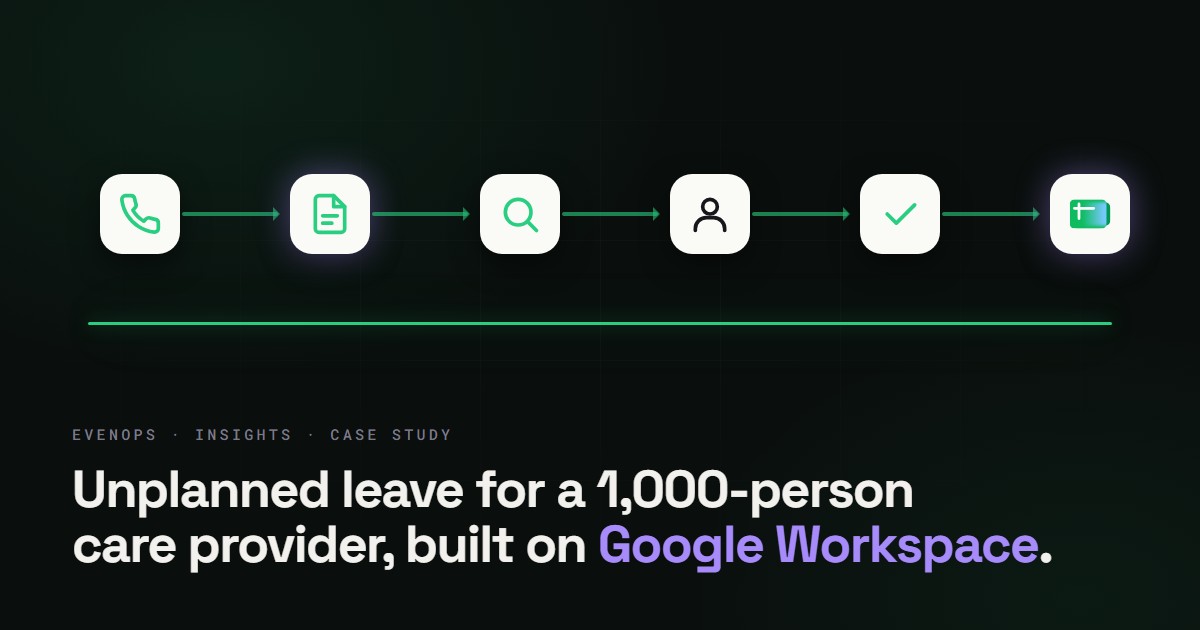
One repeatable loop takes a spiky, manual workflow and flattens it into a system that runs quiet and on time. Four phases, plain English, production code you own at the end.
A healthy system draws a flat line, no spikes, no incidents, no drama. Every engagement walks the same four steps to get there. You always know which one you are in and what lands next.
Audit.
We map the manual work
We sit with your team and trace the repetitive work end to end, where the hours go, which tools you already pay for, and where automation pays back fastest. Nothing gets built yet.
You see
A written map of the workflow and the time it costs.
You get
A ranked shortlist of what to automate first, by payback.
Blueprint.
We write it down before we build
Every project starts with a plain-English scope: what the system will do, which tools it touches, how it fails safely, and what “done” looks like. You approve it before a line of code is written.
You see
A scope document you could hand to any developer.
You get
A fixed shape, timeline, and quote, no moving targets.
Wire.
We build and connect the systems
We build the automation as production code, wire it into the tools you already use, and test it against real cases. You watch it come together in short, working increments, not a big-bang reveal at the end.
You see
Working increments you can try as they land.
You get
Tested, documented systems, source and keys in your name.
Run.
It runs flat, and we hand it over
We deploy with monitoring, error handling, and a runbook, then hand the keys to your team. The system runs quietly in the background while we stay on call for fixes and the next iteration.
You see
A live system with monitoring and a runbook.
You get
Something your team can own and extend without us.
And it compounds. Each build leaves systems behind, connectors, scripts, and patterns your next automation plugs straight into. The second project is faster than the first, and the line gets flatter every time.
Working systems in weeks, not slide decks in months
Weeks, not months.
Most automation projects spend their first month on decks and discovery theatre before anything runs. We think that is backwards. The Audit takes days; the first working increment lands in weeks.
Judge the work, not the pitch.
Any slides we show describe a system that already exists. You measure the engagement by what it does in your tools, not by how well it is presented in a meeting.
A third option.
Build it in-house and drown, or buy rigid SaaS that half-fits, most teams pick between those two. We are the third: bespoke systems built fast, then handed to you to own.
Where the Even Line starts
Every engagement opens the same way, with the Audit, run as a paid working session. We diagnose where automation pays off and hand you the written map and shortlist to keep, credited toward the build if you go ahead. Not sure it is a fit yet? Tell us what is spiking your week and we will point you to the simplest path, even if that is not us.
Every automation ships as version-controlled Apps Script, tested, documented, and deployed to your Workspace. You get the full source, the deploy pipeline, and the keys. No black-box subscriptions, no vendor lock-in.
Source delivered
Clasp + Git
Tested & documented
weeklyReport.gsApps Script
function sendWeeklyReport() {
// 1. Pull the latest rows from the dashboard sheetconst rows = SpreadsheetApp
.getActive()
.getSheetByName('KPIs')
.getDataRange().getValues();
// 2. Aggregate this week's numbersconst summary = aggregateWeek(rows);
// 3. Render an HTML email and send
GmailApp.sendEmail(
'team@company.com',
'Weekly KPI Report',
'',
{ htmlBody: renderReport(summary) }
);
}
// Trigger: every Monday at 9am, automatically.
ScriptApp.newTrigger('sendWeeklyReport')
.timeBased().everyWeeks(1).onWeekDay(ScriptApp.WeekDay.MONDAY)
.atHour(9).create();
Continues · Ready to flatten the line?
Ready to flatten the line?
Start with the Audit. We'll map where automation pays off and hand you a real plan, whether or not we end up building it for you.