Less AI hype. More how it actually works.
Practical notes on AI and automation, written from the work, not a marketing deck.
AI Agents for Business: A Practical Guide
What AI agents actually are, where they earn their keep, and how to deploy them without the hype.
A defined job → Decide the steps → Act across your tools → Guardrails → Escalate
Workflow Automation: How to Automate the Right Things
A practical guide to spotting the work worth automating and building systems that actually stick.
Honest audit → Pick the work → Build → Keep it running
Engineering AI & Automation That Ships
The build practices behind automation that survives contact with production.
Dedup → Retries → Monitoring → Fail loudly → Hand over
Latest
3 posts- PeopleOctober 11, 2026 · 7 min
Approval workflows in Google Forms and Sheets, without an add-on
A request comes in, the right person approves it with one click, nobody has to chase, and there is a record. You can build that inside Google Workspace with a Form, a Sheet and Apps Script. Here is the design, and the five things that break once real volume arrives.
Read - OperationsOctober 4, 2026 · 6 min
AI shopping agents can now buy from your store. Is your data ready?
In September Shopify switched checkout on for AI shopping agents. An agent does not see your homepage; it reads your product data and believes it. Here is what changed, where stores lose the sale, and the four checks to run before your first agent order.
Read - ReportingSeptember 29, 2026 · 6 min
AI-ready data: four tests before you add an AI step
Gartner expects most AI projects without AI-ready data to be abandoned through 2026. The model is rarely the reason. Here is what AI-ready data means for a small business, the workflow that sits under an AI step that works, and four tests you can run on your own data this week.
Read
Automation
10 postsWhat changed in Google Workspace this September, and what it means for your automations
Workspace Studio flows can now run your own Apps Script steps and call webhooks, Sheets doubled its cell limit to 20 million, Apps Script data regions went GA, and Gemini connects to QuickBooks, HubSpot and Salesforce. A working read of 4 announcements.
- September 20, 2026
- 6 min
Studio flows → Sheets → Apps Script → Gemini
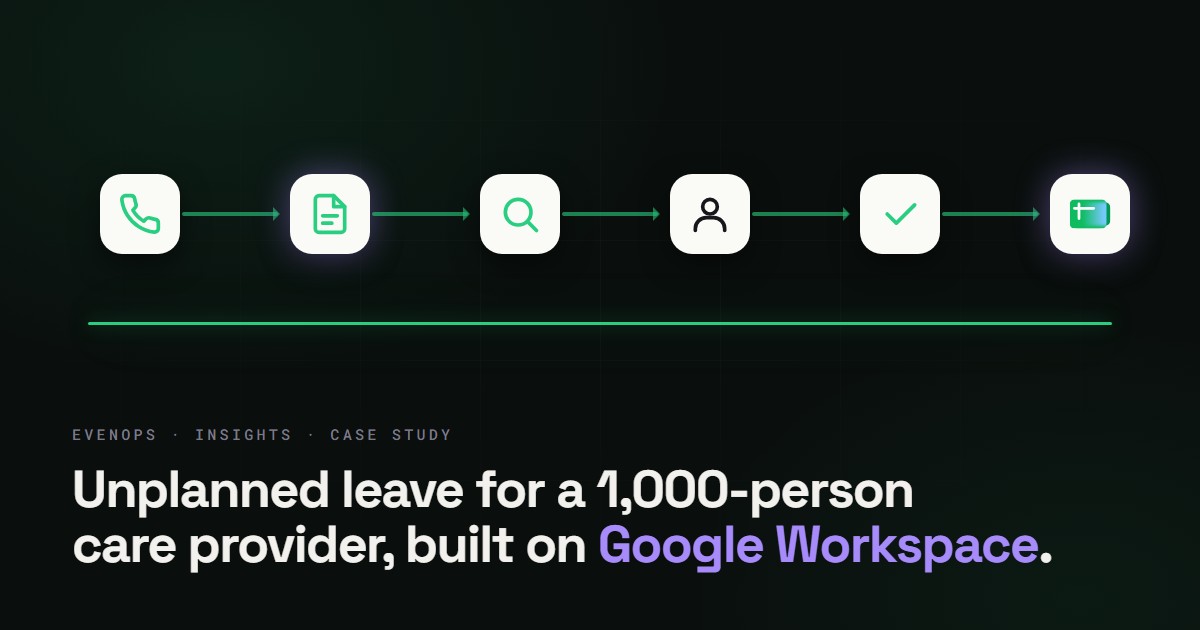
Case study: unplanned leave for a 1,000-person care provider, built on Google Workspace
A disability services provider handled unplanned leave by phone and email across more than 1,000 staff. Here is what we built inside their own Workspace, why the pilot ran at one site first, and what the hard parts turned out to be.
- September 16, 2026
- 7 min
One request → Staff lookup → Approver → Decision → Payroll record
AI invoice processing that actually ships
Most invoice-extraction demos look great and break in week two. Here's how we built a 14-supplier pipeline that runs unattended in production.
- 6 min
Watcher → Dedup → AI reads → Supplier tab → Master sync → Daily summary
Data pipelines for teams without a data team
Most small and mid-size companies don't need a data warehouse. They need three reliable pipelines and a place to look at the numbers.
- 8 min
Scheduled pull → Validate shape → Standardize → Land with history → Weekly report
Shopify order ops: where automation actually pays for itself
Most Shopify stores automate the marketing side first and leave the operational grind, the part that actually eats hours, completely manual.
- 8 min
Orders and feeds → Rules check → AI where needed → Exceptions → Load test
Document AI beyond invoices: contracts, forms, and the messy middle
Invoices get all the attention because they're structured. Contracts, intake forms, and scanned correspondence are where document AI actually gets hard.
- 8 min
Document in → OCR check → Model reads → Route → Person confirms → Source kept
Reporting automation people actually read
An automated report nobody opens is worse than no automation at all, it's effort spent making noise. How to build reporting that gets read.
- 5 min
Pull the numbers → What changed → Exceptions → Push it → Measure
The e-commerce back office nobody automates
Storefronts get all the design attention. The order-to-fulfillment plumbing behind them is where the real operational cost quietly sits.
- 6 min
Storefront order → Inventory sync → Fulfilment → Refunds
Document extraction beyond the happy path
AI can read a clean PDF in a demo every time. Production documents are scanned sideways, half-legible, and inconsistent. Here's what actually holds up.
- 7 min
Intake → Extract → Confidence → Review queue → System of record
What code-running chat tools actually change for business reporting
The new breed of chat tools writes and runs Python against your data right in the conversation. Genuinely useful, with a genuinely narrow lane.
- 5 min
Upload a sheet → Model runs Python → Result → Scheduled job → Delivered
Strategy
11 postsAP automation in 2026: what the research says, and what a 20-person business should do about it
New surveys put the share of finance teams still keying invoices by hand at about 2 in 3, and SMB adoption of AI at its highest yet. A read of the 2026 numbers, where they mislead, and a 3-step plan that fits a business without a finance department.
- September 12, 2026
- 7 min
Intake → Model reads → Checks → Review tab → Your Sheet
How to choose an automation partner (without getting locked in)
The cheapest quote often becomes the most expensive system. A short checklist for hiring someone to automate your business, ownership first.
- 6 min
Short cycles → Full source → Your accounts → Runbooks
When automation is worth it (and when it isn't)
Not every manual task should be automated. A simple framework for deciding what to automate first, and what to leave alone.
- 5 min
How often? → Rules-based? → Error cost? → Automate it
Hiring an automation team vs. outsourcing it
The build-vs-buy question for automation isn't about cost. It's about which failure mode your organization can actually tolerate.
- 8 min
Count the weeks → Steady work → Bursty work → Hybrid → Either way
The handoff is the product
The code working on delivery day isn't the deliverable. Whether your team can run it without you six months later is the actual deliverable.
- 7 min
Runbook → Where things live → What normal is → When it breaks → Cold-reader test → Transition
Why your AI pilot never became a product
Pilots are optimized to impress a room, not to survive contact with real usage. Here's the gap that kills most of them before they reach production.
- 8 min
Pilot → Who owns it? → Tenth edge case → Cost at 10x → Phase two
The real cost of running AI agents in production
Token pricing looks cheap in a spreadsheet. Multiply it by retries, context windows, and idle polling loops and the bill tells a different story.
- 8 min
Plan → Use tools → Check output → Format reply → Retries
What we learned shipping automation this year
A year of client automation work, distilled into the patterns that held up and the assumptions that didn't survive contact with production.
- 7 min
Scoped process → Exceptions → Monitoring → Handoff
What a good handoff actually looks like
The build is the easy 80%. Handing off a system a client's team can actually run without you is the part most agencies skip.
- 5 min
Your credentials → Runbook → Walkthrough → Next year's list
Scoping an automation project that won't balloon
The fastest way to blow a budget is an open-ended discovery phase. A concrete method for scoping automation work before a single line of code.
- 6 min
Walk the process → Exceptions first → Three real examples → Out of scope → Fixed price
What 2023 actually taught us about shipping AI, not demoing it
A year of frontier models in the wild changed what 'automation' means for small businesses. Looking back at what held up, what didn't, and what we're carrying into next year.
- 6 min
Demo → The gap → Boring infrastructure → Model routing → Human approval
AI Agents
5 postsEveryone sells agents now. Most of what you need is not an agent.
Agentic AI is the loudest pitch of the year. But for most back-office work, a pipeline with one well-placed model step beats an autonomous agent on cost, reliability, and sleep. Here are the three questions that tell you which one you actually need.
- September 4, 2026
- 6 min
Fetch → Extract → Check → Write → Checkpoint
AI agents vs. chatbots: what actually reduces support load
Most support bots just deflect. An AI agent that can read your docs and take action is a different thing entirely. Here's where each one earns its keep.
- 5 min
Ticket in → Reads knowledge → Takes action → Knows its limits → Improves
What AI agents can't do yet, and how to design around it
The gap between what agent demos show and what agents reliably do in production is real, specific, and worth designing for instead of ignoring.
- 9 min
Scope autonomy → Short stages → Checkpoints → Ask, not guess → Human confirms
Design agent permissions before you design agent capability
The instinct is to ask what an AI agent should be able to do. The better first question is what it should never be allowed to do unsupervised.
- 6 min
Boundary first → Scoped keys → Tiered autonomy → Hard caps → Kill switch
RAG isn't optional anymore: why retrieval beats fine-tuning for most use cases
Everyone asking for a 'custom-trained AI' actually needs retrieval-augmented generation. Here's why that's the right answer for almost every business use case we've seen.
- 6 min
Chunk → Embed → Store → Question → Retrieve → Answer
Engineering
15 postsAutomating sensitive data without creating a compliance problem
When automation touches health, financial, or personal data, security can't be an afterthought. How to get the efficiency without the risk.
- 5 min
Agree terms → Least privilege → Secrets in a vault → Audit trail
Google Apps Script: the most underrated automation tool
Before you buy another SaaS subscription, look at what's already sitting inside your Google Workspace. It's more capable than people think.
- 5 min
Schedule → Pull data → Summarize → Email report
The security review every AI integration needs before launch
AI integrations open new paths for data to leak that a standard security checklist doesn't cover. Here's what to check before anything touches production.
- 8 min
Job description → Keycard → Manager → Probation → Weekly review
Monitoring AI systems like you monitor infrastructure
Most AI features ship with no observability at all. You find out they're broken when a customer complains, which is the same as not monitoring your servers.
- 8 min
Log in and out → Cost per request → Latency tail → Weekly sample → Eval cases → Named owner
CRM integrations break in the same five places
Every CRM integration project looks the same on the whiteboard and breaks in the same handful of spots once real data hits it.
- 8 min
Field owners → Idempotent writes → Dead-letter queue → Reconciliation → Real-shaped tests
Evals are the part nobody wants to build
Everyone wants to ship the AI feature. Almost nobody wants to build the harness that proves it still works after the next change. That's the mistake.
- 8 min
Golden set → Score → Track → Gate → New case
What retrieval-augmented generation actually gets wrong
RAG demos work on ten clean documents and fall apart on ten thousand messy ones. The failure modes are predictable once you've seen them a few times.
- 9 min
Versioned ingest → Chunk by meaning → Filter first → Hybrid search → Rerank → Relevance floor
Monitoring automation you can't watch manually
The whole point of automation is that nobody has to watch it. That only works if the monitoring is actually good enough to replace watching it.
- 5 min
Did it run? → Right amount? → Makes sense? → Alert
Idempotency: the boring fix that prevents the worst automation bugs
Most catastrophic automation failures trace back to one missing property: the pipeline wasn't safe to run twice. Here's how to build for it.
- 6 min
Event → Stable key → Already done? → Upsert → Run it twice
Cost control for AI pipelines before the bill surprises you
Token costs scale with volume in ways that are easy to miss until the first invoice. How to design AI pipelines with cost as a first-class constraint.
- 6 min
Route → Cache → Batch → Hard ceiling → Cost math
Before you build a CRM integration, answer these five questions
CRM integrations look simple until you hit the field mapping, the dedup logic, and the sync direction nobody agreed on. A pre-flight checklist.
- 6 min
Who wins? → Duplicates → Direction → Failed records → Field owners → Sync contract
The real cost of a broken integration
A single silent failure in a data sync can cost more than the entire automation saved. Here's how to price the risk before you ship.
- 6 min
Sync runs → Sanity check → Abnormal? → Fail loudly → Write
128k context windows: what actually changes when the model can read more
This month's headline model release bumped the context window to 128k tokens at a much lower price. That's not just 'more room,' it changes which architectures make sense.
- 6 min
Source material → Fits the window? → Whole document in → Model answers → Test it
Prompt injection is the SQL injection of this generation, and most teams aren't ready
If your AI agent reads untrusted text, whether that's an email, a web page, or a customer message, it can be manipulated by that text. Here's what that risk actually looks like.
- 6 min
Untrusted text → Read as data → Permission boundary → Approval → Log it
What we learned putting frontier models in production this year
Frontier model API access opened up in March. Four months in, here's what actually breaks when you move past the playground and into a real pipeline.
- 6 min
Messy input → Fast model → Route → Strongest model → Validate