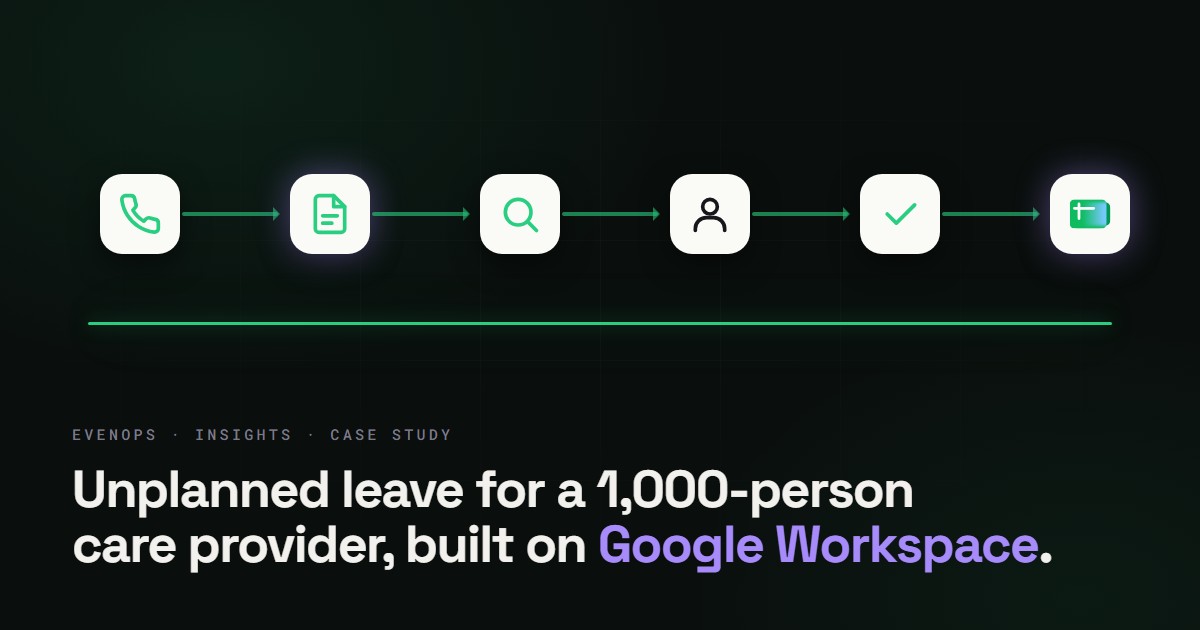
Flag stale Sheet rows and nudge the owner in Gmail
Rows sit untouched in a tracking sheet, an unpaid invoice, a lead with no follow-up, and nobody notices until someone happens to scroll past it.
Rows that sit untouched in a tracking sheet past a threshold, such as an unpaid invoice or a lead with no follow-up, can be detected on a schedule and the owner nudged by Gmail with the row's detail. Evenops builds the check in Apps Script so stalled rows surface on schedule while rows that are moving stay quiet.
How does it run?
3 stepsStep 01Trigger
Scheduled check scans the sheet for rows past their threshold
Step 02Match
Stale rows matched to an owner
Step 03Send
Gmail nudge sent to the owner with the row's detail
What do you get?
3 outcomes- ✓Stale rows surface on schedule, not by accident
- ✓The nudge goes to the right owner automatically
- ✓Rows that are moving stay quiet
Which tools does it use?
Time saved
Catches stalled rows nobody remembers to check.What does the script do?
An Apps Script pair for a tracking Sheet. One part stamps a Last updated date whenever a person edits a row. The other runs every morning, finds rows that are not finished and have been untouched for a number of days, groups them by owner, and sends each owner one email listing their quiet items with a link to the sheet. It marks the rows as nudged so they are not chased again until the repeat period passes. Rows with no readable date or no valid owner, and runs that could not email every owner, are reported to an administrator rather than skipped.
What do you need first?
- A Google Sheet with a heading row and columns for the item, the owner's email, a status, Last updated and Last nudged. The last two can be empty.
- A list of statuses that mean finished, such as Done or Paid.
- A shared mailbox for the administrator report.
- About 25 minutes. No paid add-on.
How do you set it up?
7 stepsCreate the script
Open script.google.com in the account that owns the tracker, create a project and paste the code below into Code.gs.
Fill in CONFIG
Set SPREADSHEET_ID and SHEET_NAME, the heading names, DONE_STATUSES, STALE_DAYS, REPEAT_DAYS and ADMIN_EMAIL.
Run it once by hand
Use your own address as the owner on a few test rows. Pick nudgeStaleRows and press Run, and authorise Sheets and email access. Rows with no Last updated date are given today's date, which starts their clock, and the administrator email says how many.
Install the triggers
Pick installTriggers and press Run once. It schedules nudgeStaleRows daily between 8 and 9 AM in the script's time zone, and adds an edit trigger that runs stampEdit when a person changes the sheet. Earlier copies are replaced.
Check the stamp
Edit a cell in a test row and confirm Last updated changes to now. Editing the Last updated or Last nudged cells themselves does not count as an update.
Agree the rules with the team
A row stops appearing when its Status is a finished one, or when someone updates it. Clearing Last nudged makes it eligible again.
Turn on failure emails
In Triggers, set Failure notification settings on both triggers to notify you immediately.
The script
// Finds rows in a tracking Sheet that nobody has touched for a while and emails each owner one list.
// Paste into Code.gs in a new project at script.google.com, edit CONFIG, run installTriggers() once.

const CONFIG = {
  SPREADSHEET_ID: 'PASTE_THE_SPREADSHEET_ID_HERE',
  SHEET_NAME: 'Tracker',
  ITEM_HEADER: 'Item',             // the sheet's column headings, spelled exactly
  OWNER_HEADER: 'Owner email',
  STATUS_HEADER: 'Status',
  UPDATED_HEADER: 'Last updated',  // stamped automatically when someone edits the row (see stampEdit)
  NUDGED_HEADER: 'Last nudged',    // written by the script
  DONE_STATUSES: ['Done', 'Closed', 'Paid', 'Lost'], // rows with these statuses are never chased
  STALE_DAYS: 7,                   // untouched for this many days counts as stale
  REPEAT_DAYS: 7,                  // do not nudge the same row again for this many days
  MAX_ROWS_PER_EMAIL: 40,
  // Stop well before the 6 minute limit. On a gmail.com account the whole day's
  // trigger time is 90 minutes, so lower this (for example 60 * 1000) there.
  TIME_BUDGET_MS: 4 * 60 * 1000,
  ADMIN_EMAIL: 'ops@example.com',  // hears about rows the script cannot act on
};

const MONTHS = ['jan', 'feb', 'mar', 'apr', 'may', 'jun', 'jul', 'aug', 'sep', 'oct', 'nov', 'dec'];
const EMAIL_PATTERN = /^[^\s@]+@[^\s@]+\.[^\s@]+$/;

function nudgeStaleRows() {
  const lock = LockService.getScriptLock();
  if (!lock.tryLock(30 * 1000)) return;
  const started = Date.now();
  const props = PropertiesService.getScriptProperties();
  // Anything the administrator could not be emailed about last time is carried over.
  let admin = [];
  try { admin = JSON.parse(props.getProperty('pendingAdmin') || '[]'); } catch (e) { admin = []; }
  try {
    const ss = SpreadsheetApp.openById(CONFIG.SPREADSHEET_ID);
    const sheet = ss.getSheetByName(CONFIG.SHEET_NAME);
    if (!sheet) throw new Error('There is no tab called ' + CONFIG.SHEET_NAME);
    const tz = ss.getSpreadsheetTimeZone();
    const today = Utilities.formatDate(new Date(), tz, 'yyyy-MM-dd');

    // One read of the tab; every decision below is made in memory.
    const grid = sheet.getDataRange().getValues();
    const headers = grid[0].map(String);
    const col = {
      item: headers.indexOf(CONFIG.ITEM_HEADER), owner: headers.indexOf(CONFIG.OWNER_HEADER),
      status: headers.indexOf(CONFIG.STATUS_HEADER), updated: headers.indexOf(CONFIG.UPDATED_HEADER),
      nudged: headers.indexOf(CONFIG.NUDGED_HEADER),
    };
    Object.keys(col).forEach(function (k) {
      if (col[k] < 0) throw new Error('A column heading is missing from the sheet: ' + k);
    });

    const byOwner = {};      // owner email -> stale rows, built in one pass
    const startClock = [];   // rows that have no Last updated yet
    for (let i = 1; i < grid.length; i++) {
      const row = grid[i];
      const item = String(row[col.item]).trim();
      if (item === '') continue;
      const status = String(row[col.status]).trim().toLowerCase();
      if (CONFIG.DONE_STATUSES.some(function (s) { return s.toLowerCase() === status; })) continue;

      if (String(row[col.updated]).trim() === '') { startClock.push(i + 1); continue; }
      const updated = dateKey_(row[col.updated], tz);
      if (!updated) { admin.push('Row ' + (i + 1) + ' (' + item + '): Last updated could not be read'); continue; }
      if (daysBetween_(updated, today) < CONFIG.STALE_DAYS) continue;

      const nudgedRaw = String(row[col.nudged]).trim();
      const nudged = nudgedRaw === '' ? null : dateKey_(row[col.nudged], tz);
      // An unreadable Last nudged is reported, and the row is treated as never nudged.
      if (nudgedRaw !== '' && !nudged) admin.push('Row ' + (i + 1) + ' (' + item + '): Last nudged could not be read, so the row was treated as not nudged yet');
      if (nudged && daysBetween_(nudged, today) < CONFIG.REPEAT_DAYS) continue;

      const owner = String(row[col.owner]).trim().toLowerCase();
      if (!EMAIL_PATTERN.test(owner)) { admin.push('Row ' + (i + 1) + ' (' + item + '): no valid owner email'); continue; }
      (byOwner[owner] = byOwner[owner] || []).push({ rowNumber: i + 1, item: item, days: daysBetween_(updated, today) });
    }

    // One email per owner. A row is marked as nudged only after its email has gone.
    const nudgedCells = [];
    let held = 0;
    Object.keys(byOwner).forEach(function (owner) {
      if (Date.now() - started > CONFIG.TIME_BUDGET_MS || MailApp.getRemainingDailyQuota() < 1) { held++; return; } // tomorrow's run carries on
      const list = byOwner[owner];
      const shown = list.slice(0, CONFIG.MAX_ROWS_PER_EMAIL);
      const lines = shown.map(function (r) { return '- Row ' + r.rowNumber + ': ' + r.item + ' (' + r.days + ' days untouched)'; });
      if (list.length > shown.length) lines.push('...and ' + (list.length - shown.length) + ' more in the sheet.');
      try {
        MailApp.sendEmail(owner, 'Tracker: ' + list.length + ' item(s) have gone quiet',
          'These items have not been updated for ' + CONFIG.STALE_DAYS + ' days or more:\n\n' + lines.join('\n') +
          '\n\nOpen the tracker: ' + ss.getUrl() + '\nUpdate the row, or set its Status to Done, and it stops appearing here.');
        list.forEach(function (r) { nudgedCells.push(toA1_(col.nudged, r.rowNumber)); });
      } catch (err) {
        admin.push('Could not email ' + owner + ': ' + err.message);
      }
    });

    if (held) admin.push(held + ' owner(s) were not emailed this run because the time budget or the daily email quota ran out. They are picked up by the next run.');

    // Two batched writes: the nudge dates, and a start date for rows that had none.
    if (nudgedCells.length) sheet.getRangeList(nudgedCells).setValue(new Date());
    if (startClock.length) {
      sheet.getRangeList(startClock.map(function (n) { return toA1_(col.updated, n); })).setValue(new Date());
      admin.push(startClock.length + ' row(s) had no Last updated date, so their clock started today (rows ' + startClock.slice(0, 10).join(', ') + (startClock.length > 10 ? '...' : '') + ')');
    }
  } catch (err) {
    admin.push('Run failed: ' + err.message);
  } finally {
    lock.releaseLock();
  }
  if (admin.length) {
    admin = admin.filter(function (line, i) { return admin.indexOf(line) === i; });
    try {
      MailApp.sendEmail(CONFIG.ADMIN_EMAIL, 'Tracker nudges: ' + admin.length + ' thing(s) to look at', admin.join('\n'));
      props.deleteProperty('pendingAdmin');
    } catch (err) {
      // Most likely the daily email quota. Keep the report for the next run.
      try {
        while (admin.length > 1 && JSON.stringify(admin).length > 6000) admin.shift();
        props.setProperty('pendingAdmin', JSON.stringify(admin));
      } catch (e) { /* the store itself is down */ }
    }
  }
}

// Installable on-edit trigger: stamps Last updated when a person edits a row.
// It does not run for edits made by scripts, imports or form submissions.
function stampEdit(e) {
  try {
    if (!e || !e.range) return;
    const sheet = e.range.getSheet();
    if (sheet.getName() !== CONFIG.SHEET_NAME || e.range.getLastRow() < 2) return;
    const headers = sheet.getRange(1, 1, 1, sheet.getLastColumn()).getValues()[0];
    const stampCol = headers.indexOf(CONFIG.UPDATED_HEADER) + 1;
    const nudgedCol = headers.indexOf(CONFIG.NUDGED_HEADER) + 1;
    if (!stampCol) return;
    const first = e.range.getColumn();
    const last = e.range.getLastColumn();
    if (first === last && (first === stampCol || first === nudgedCol)) return; // editing the stamp itself is not an update
    const firstRow = Math.max(e.range.getRow(), 2);
    const count = e.range.getLastRow() - firstRow + 1;
    const stamps = [];
    for (let i = 0; i < count; i++) stamps.push([new Date()]);
    sheet.getRange(firstRow, stampCol, count, 1).setValues(stamps);
  } catch (err) {
    reportStampFailure_(err);
  }
}

// A failing edit trigger would otherwise be silent. At most one email an hour, to the administrator.
function reportStampFailure_(err) {
  try {
    const props = PropertiesService.getScriptProperties();
    const last = Number(props.getProperty('lastStampAlertAt') || 0);
    if (Date.now() - last < 60 * 60 * 1000) return;
    MailApp.sendEmail(CONFIG.ADMIN_EMAIL, 'Tracker: the edit stamp failed', 'Last updated is not being stamped: ' + err.message);
    props.setProperty('lastStampAlertAt', String(Date.now()));
  } catch (e) { /* nothing more can be done from inside a trigger */ }
}

function toA1_(zeroBasedCol, rowNumber) {
  let n = zeroBasedCol + 1;
  let letters = '';
  while (n > 0) { const r = (n - 1) % 26; letters = String.fromCharCode(65 + r) + letters; n = Math.floor((n - 1) / 26); }
  return letters + rowNumber;
}

// Reads a date the way a person might have typed it. Returns 'yyyy-MM-dd' or null.
// Real date cells are read in the spreadsheet's time zone. Text is read day first: 5/11/2026 is 5 November.
function dateKey_(value, tz) {
  if (value instanceof Date) return isNaN(value.getTime()) ? null : Utilities.formatDate(value, tz, 'yyyy-MM-dd');
  const s = String(value).trim();
  let y, m, d, parts;
  if ((parts = /^(\d{4})-(\d{1,2})-(\d{1,2})/.exec(s))) {
    y = +parts[1]; m = +parts[2]; d = +parts[3];
  } else if ((parts = /^(\d{1,2})[\/.\-](\d{1,2})[\/.\-](\d{2}|\d{4})$/.exec(s))) {
    d = +parts[1]; m = +parts[2]; y = +parts[3];
    if (y < 100) y += 2000;
  } else if ((parts = /^(\d{1,2})\s+([A-Za-z]{3,9})\.?,?\s+(\d{4})$/.exec(s))) {
    d = +parts[1]; m = MONTHS.indexOf(parts[2].slice(0, 3).toLowerCase()) + 1; y = +parts[3];
  } else {
    return null;
  }
  const t = new Date(Date.UTC(y, m - 1, d));
  if (m < 1 || t.getUTCFullYear() !== y || t.getUTCMonth() !== m - 1 || t.getUTCDate() !== d) return null; // 31/02 is not a date
  return t.toISOString().slice(0, 10);
}

function daysBetween_(fromKey, toKey) {
  return Math.round((Date.parse(toKey) - Date.parse(fromKey)) / 86400000);
}

// Run once by hand. Safe to run again: it replaces the old triggers.
function installTriggers() {
  ScriptApp.getProjectTriggers()
    .filter(function (t) { return ['nudgeStaleRows', 'stampEdit'].indexOf(t.getHandlerFunction()) !== -1; })
    .forEach(function (t) { ScriptApp.deleteTrigger(t); });
  ScriptApp.newTrigger('nudgeStaleRows').timeBased().everyDays(1).atHour(8).create();
  ScriptApp.newTrigger('stampEdit').forSpreadsheet(CONFIG.SPREADSHEET_ID).onEdit().create();
}
Every Apps Script method in this script was checked against Google's Apps Script reference (developers.google.com/apps-script/reference) on 11/10/2026. Limits come from Google's quota table, checked the same day. The trigger restrictions and the edit event fields were checked against Google's triggers guides the same day.
What should you know before relying on it?
10 caveats- Quotas
- Google's quota table lists a 6 minute limit per execution, 20 triggers per user per script, and a total trigger runtime of 90 minutes a day on a gmail.com account or 6 hours a day on Google Workspace. The daily run is one run a day, so it is not a concern. The edit trigger is: it runs once for every edit a person makes, and each run is short but counts towards the same daily total. At 500 edits a day a gmail.com account has about 11 seconds per edit and Workspace about 43. The quota table also lists 100 email recipients a day on gmail.com and 1,500 on Workspace: each owner is one recipient, and the script stops sending when Google reports none left, leaving those rows for tomorrow and telling the administrator how many owners were held back. Open Executions in the Apps Script editor to see how long your runs really take.
- What counts as an update
- Google's guide says script executions and API requests do not cause triggers to run. Rows added by a script or an API call therefore get no stamp, and rows added by a form or an import may not either, so do not rely on the edit trigger for them. The daily run gives such a row a start date the first time it sees it, so it is chased from then, and tells the administrator.
- Idempotency
- A row is marked nudged only after the owner's email has gone. If a send fails, the row is left unmarked and the administrator is told. After a nudge, a row stays quiet for REPEAT_DAYS.
- Stays fast as the sheet grows
- The tab is read once, rows are grouped by owner in memory, and the nudge dates are written in one batched call. The sheet is not searched again for each row or each owner.
- Dates are read, not guessed
- Real dates, 2026-11-15, 15/11/2026 and 15 Nov 2026 are understood, read day first. Anything else, in Last updated or in Last nudged, is reported to the administrator with its row number every morning until it is fixed. An unreadable Last nudged is treated as never nudged, so the row is still chased.
- If the edit stamp breaks
- A failing edit trigger would otherwise be silent. The stamp function catches its own errors and emails ADMIN_EMAIL, at most once an hour.
- A nudge is not a judgement
- The script knows a row has not been edited, not whether work is happening elsewhere. Keep the email short and let the owner decide, and set STALE_DAYS to a length that fits your work.
- Email lists are capped
- One email lists at most MAX_ROWS_PER_EMAIL (40) rows and says how many more there are, so a very long list does not become an unreadable message. All of the rows are marked nudged.
- Plain email
- The messages are plain text, so nothing from the sheet is placed in HTML. The only values the script writes into the sheet are dates.
- Ownership
- Both triggers run as the account that installed them, and the emails come from it. If that person leaves and the account is suspended, nudges stop. Install it from a dedicated shared Workspace user the business owns.
When should you call us?
A morning nudge from a tracker is a good fit for a script. Call us when stale items should be escalated up a chain, when the right owner depends on the item, when the status lives in a CRM or helpdesk rather than a sheet, or when you need a record of what was chased and what happened next. We build that with monitoring and a runbook.
Tell us what you needContinues · Want this wired into your stack?
Want this wired into your stack?
Tell us your tools and the task. We'll scope it and build it as production code you own.
We typically respond within 24 hours